What is the best seamless flooring for a hospital or healthcare facility?
Flooring in clinical and research environments carries compliance requirements that standard commercial flooring can't meet. Grout lines harbor pathogens. Porous concrete absorbs chemical spills. Tile joints fail under repeated chemical washdown. DTI installs seamless, non-porous flooring systems engineered for the infection control, chemical resistance, and durability standards required in healthcare and laboratory settings.
The usual hospital specification is a chemical-resistant or antimicrobial resinous system with integral cove base. System selection follows the actual disinfectants, chemical exposure, thermal cycling, equipment, and use of each space. DTI also installs urethane cement, grounded ESD epoxy, and sealed polished concrete where those requirements call for a different wearing surface.
Why does seamless flooring matter for infection control?
Standard tile and VCT floors have grout lines and seams. In a clinical environment, those seams are where bacteria, fungi, and chemical residue accumulate - and where standard mops and cleaning chemicals cannot reach. A seamless epoxy or resinous floor eliminates that risk entirely. One continuous surface, no joints, no ledges, no grout to degrade.
For laboratory environments, the same logic applies to chemical containment. A seamless floor with integral cove base means spills stay on the floor surface - they don't migrate into wall cavities or subfloor assemblies.
- No grout lines - no pathogen harboring sites
- No seams - no chemical migration paths
- Integral cove base eliminates floor-to-wall contamination points
- Supports hospital-grade disinfectant protocols without degradation
- One surface, one cleaning procedure, full coverage
Grout lines, seams, and welded joints are where pathogens survive cleaning. A seamless resinous floor with integral cove base gives environmental services one continuous, non-porous surface that hospital-grade disinfectants can fully wet and dwell on - no joints to harbor bacteria, no seams for fluids to migrate beneath.
Removing seam-related collection sites supports infection control; it does not replace the facility's cleaning, disinfectant, or infection-control procedures.
Which flooring standards apply to hospitals and medical facilities?
In healthcare and pharmaceutical environments, the floor is part of the regulated envelope. Hospital environmental services teams clean to CDC guidance with EPA-registered disinfectants; a floor that hazes, softens, or micro-cracks under those chemistries becomes an infection control finding. In pharmaceutical manufacturing, 21 CFR 211 requires smooth, cleanable, crack-free surfaces as part of cGMP facility qualification - and your flooring submittal package becomes part of the validation record.
Healthcare flooring must support infection control protocols (CDC environmental cleaning guidance), meet slip-resistance expectations under OSHA walking-working-surface rules, and stand up to EPA List-registered disinfectants without degrading. DTI provides written specifications and material documentation to support facility audits.
Occupied-facility work is coordinated with the facility's infection control risk assessment (ICRA). The installed system and documentation must support the actual cleaning protocols and Joint Commission survey expectations, not just carry a generic healthcare label.
Which system goes where in a healthcare facility?
Hospitals and clinical spaces
Operating rooms, patient corridors, and procedure areas require flooring that is non-porous, slip-resistant when wet, and compatible with hospital-grade disinfectants. DTI installs seamless epoxy and resinous systems that eliminate grout lines and support rigorous cleaning protocols without surface breakdown over time.
Medical office and clinical support
Flooring in exam rooms, corridors, and support spaces needs to balance hygiene requirements with durability under steady foot traffic. Polished concrete and sealed epoxy systems provide easy-clean surfaces that hold up without the maintenance overhead of VCT or tile.
Systems we install
Chemical-Resistant Epoxy
Specified by chemical resistance class. Available in standard and high-build thicknesses depending on substrate condition and exposure requirements.
Antimicrobial Epoxy Coatings
EPA-registered antimicrobial additives available for environments with heightened infection control requirements.
Urethane Cement
For areas subject to thermal cycling, steam cleaning, or autoclaving. More flexible than epoxy under temperature fluctuation - the correct specification for sterilization rooms and commercial kitchen adjacencies within medical facilities.
ESD Epoxy (Electrostatic Dissipative)
Required in areas housing sensitive electronic medical equipment. Grounded installation to ANSI/ESD S20.20 standards.
Integral Cove Base
Standard specification on all DTI medical and laboratory installations. Eliminates the seam between floor and wall - the most common contamination point in clinical flooring failures.
Sealed Polished Concrete
For clinical support and administrative areas where a clean, durable surface is required without the full chemical resistance spec of a coated system.
Imaging suites and areas with sensitive electronic medical equipment use the grounded ESD system; sterilization and autoclave areas and commercial kitchen adjacencies with thermal cycling use urethane cement. Integral cove base is the standard detailing choice across DTI medical and laboratory installations.
Can flooring be replaced in an operating hospital without disrupting patient care?
Installation in an operating facility is its own discipline. We work behind negative-air containment in coordination with your infection control risk assessment (ICRA), use low-odor and low-VOC materials near occupied spaces, and phase work so patient care and production schedules are never interrupted. Fast-cure systems return corridors and procedure rooms to service in hours.
DTI schedules around clinical operations and phases active work areas behind containment. The return-to-service window follows the selected system and the facility's requirements; coordinate release of each work area with the clinical schedule.
What flooring do research and testing labs need?
Lab floors see a wide range of chemical exposures - solvents, acids, bases, and biological agents - that standard flooring cannot withstand. We specify systems by chemical resistance class based on your actual reagent inventory, not a generic "chemical resistant" label.
Review Laboratory Flooring Options for a comparison of epoxy, urethane, and polished systems for research and testing labs, and What Regulators Look For for inspection and documentation requirements.
What flooring do pharmaceutical cleanrooms and cGMP areas need?
Cleanroom flooring must meet specific particle-generation and outgassing requirements. DTI installs ESD-safe and low-outgassing epoxy systems appropriate for ISO-classified environments, coordinated with your facility's contamination control requirements.
Cleanroom floors need to be seamless, non-shedding, low-outgassing, and compatible with sporicidal cleaning agents. Depending on classification, DTI installs high-performance epoxy or urethane systems with integral cove base, and ESD-dissipative versions where electrostatic control is part of the room specification. The submittal supports ISO 14644 qualification documentation and becomes part of the 21 CFR 211 cGMP validation record.
For the full system-selection answer, see DTI's cleanroom flooring guide.
What documentation does DTI provide for surveys and audits?
DTI specifies against your actual protocols: the disinfectant list your EVS team uses, the reagent inventory in your labs, the classification of your controlled spaces. We then document everything - surface preparation method, system build, film thickness, cove details, and manufacturer compliance letters - so the installation stands up to Joint Commission surveys, FDA inspections, and ISO qualification audits.
- Surface preparation method
- System build
- Film thickness
- Cove details
- Manufacturer compliance letters
The written system specifications and material documentation support facility audits; the pharmaceutical flooring submittal becomes part of the validation record.
What about moisture, damaged slabs and maintenance?
Where slabs have moisture problems - common in ground-floor imaging suites and below-grade support areas - our moisture mitigation systems address vapor drive before the finish floor goes down. Deteriorated substrates are rebuilt with our repair and overlay services so the new system bonds to sound concrete, and ongoing maintenance programs keep the surface within its cleanability spec for the life of the floor.
For underground and foundation-level spaces, see below-grade flooring and moisture protection. Moisture mitigation and slab repair precede the finish; maintenance supports the installed surface's cleanability over time.
From our jobs
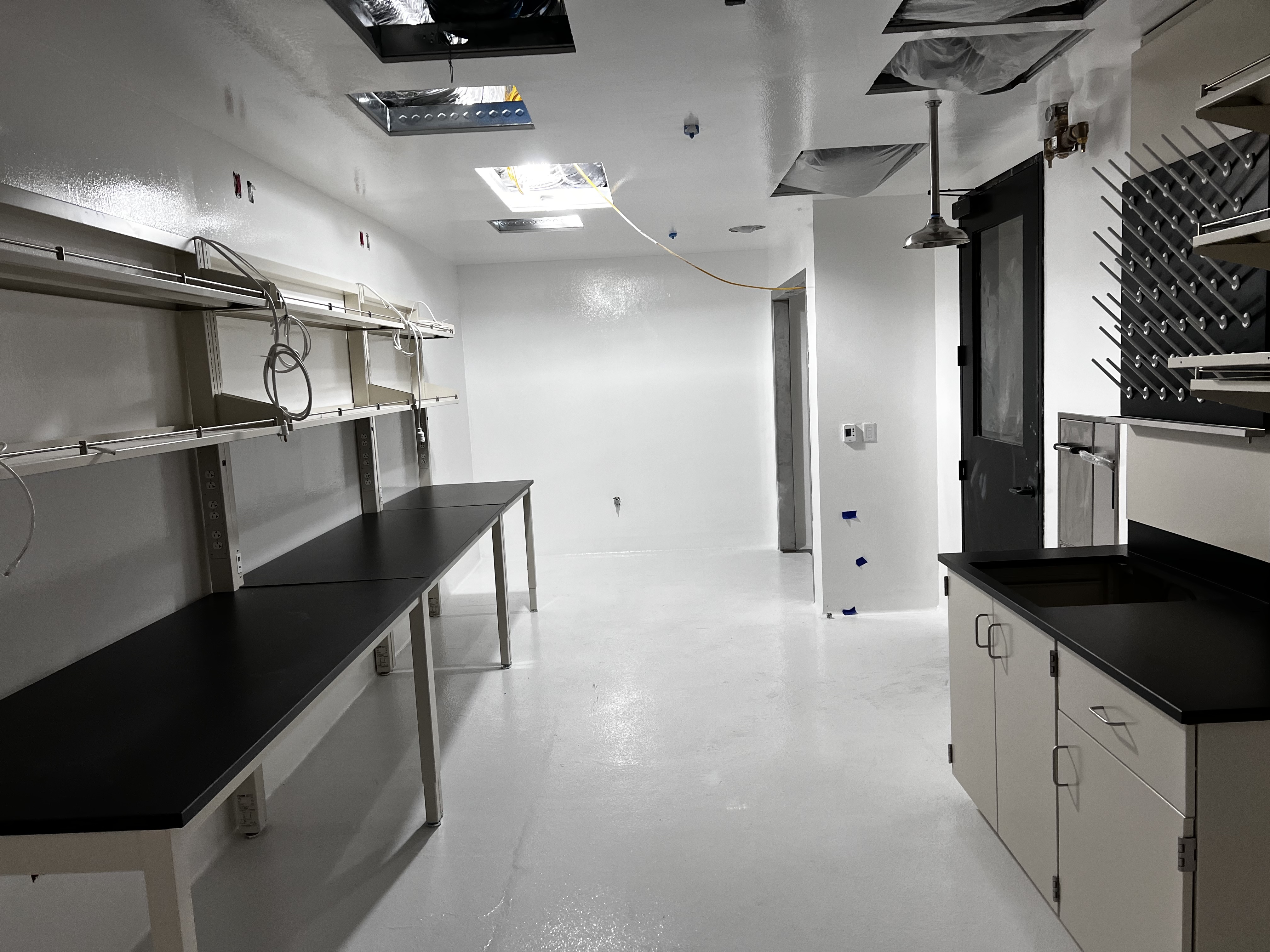 Medical / Laboratory
San Francisco, CA
Laboratory Facility
A research laboratory in San Francisco required seamless flooring to replace an existing tile system that was failing at the grout lines under repeated chemical cleaning. DTI installed a chemical-resistant epoxy system with integral cove base, eliminating all horizontal-to-vertical seams where contaminants accumulate. The seamless surface meets the facility's infection control protocol and supports daily chemical washdown without degradation.
System: Chemical-resistant seamless epoxy, integral cove base
Key requirement: Contamination control, chemical resistance, seamless surface
This documented project is a research laboratory, not an identified hospital or clinic installation. For your hospital or clinical space, request a project consultation to review the disinfectant list, infection-control requirements, and operating schedule.
Resources
In-depth guides from our team on clinical and laboratory flooring.
Laboratory Flooring Options
Comparing epoxy, urethane, and polished systems for research and testing labs.
What Regulators Look For
How inspectors evaluate lab floors - and the documentation that keeps audits short.
Antimicrobial Cleanroom Floors
The role of antimicrobial additives in controlled and clinical environments.
Serving Healthcare and Laboratory Facilities Nationwide
DTI works directly with facility managers, project owners, and general contractors on medical and laboratory flooring projects across the United States. We provide written system specifications before any work is priced - so you know exactly what is being installed and why.
Request a Project ConsultationFrequently asked questions
What is the best flooring for a hospital that needs seamless floors?
A seamless resinous system, usually chemical-resistant or antimicrobial epoxy, installed with an integral cove base. It removes grout lines, seams and the floor-to-wall joint where pathogens and chemical residue collect, and it is specified to tolerate the facility's EPA-registered disinfectants. Operating rooms and procedure areas also need wet slip resistance.
How do seamless floors support infection control?
Tile and VCT seams collect bacteria, fungi and chemical residue that mops cannot reach. A seamless floor with integral cove base has no grout-line pathogen sites, no seams for chemical migration and no floor-to-wall contamination point. It gives environmental services one surface with one cleaning procedure that supports hospital-grade disinfectant protocols.
What flooring standards apply to hospitals and medical facilities?
Healthcare floors are cleaned to CDC guidance with EPA-registered disinfectants, and a floor that hazes or micro-cracks can become an infection control finding during a Joint Commission survey. Work in occupied facilities follows an infection control risk assessment. Pharmaceutical areas fall under 21 CFR 211 cGMP requirements for smooth, cleanable, crack-free surfaces.
Can flooring be replaced in an operating hospital without disrupting patient care?
Yes. DTI installs under negative-air containment, coordinates with the facility's infection control risk assessment, uses low-odor and low-VOC materials, and phases work around patient care. Fast-cure systems return corridors and procedure rooms to service in hours rather than days, so departments are not closed for extended periods.
What flooring is best for pharmaceutical cleanrooms?
A seamless epoxy or urethane-based resinous system with integral coved base, low-outgassing materials, and ESD or conductive properties where static-sensitive product is handled, matched to the ISO 14644 class and 21 CFR 211 cGMP requirements. The flooring submittal becomes part of the validation record. See DTI's cleanroom flooring guide for system selection.
Which healthcare areas need ESD or urethane cement instead of standard epoxy?
Areas with sensitive electronic medical equipment, such as imaging suites, use grounded ESD epoxy installed to ANSI/ESD S20.20. Sterilization rooms, autoclave areas and commercial kitchen adjacencies with steam cleaning or thermal cycling use urethane cement, which flexes under temperature swings better than epoxy. Clinical support and administrative areas can use sealed polished concrete.